
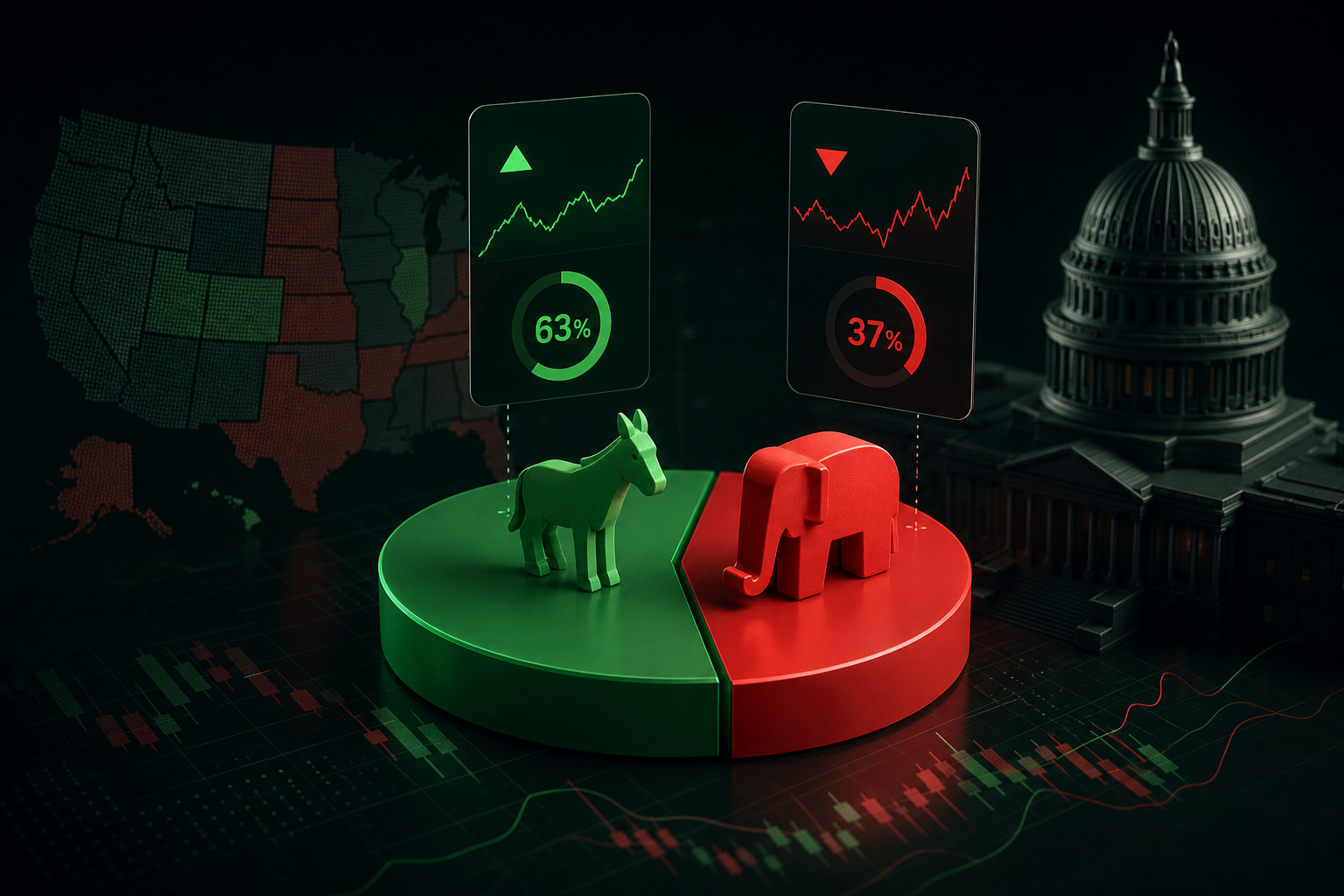
Midterm prediction markets let you convert a contract price directly into an implied probability for any House or Senate race. To read them well, find the midpoint price, check the bid-ask spread for entry cost, assess market depth for slippage risk, and pick the right order type before you commit capital. This guide walks through each of those steps in order, then covers platform selection, accuracy evidence, and the legal landscape.
What Do Midterm Prediction Market Prices Actually Mean?
A contract price is a probability. A contract trading at a given price means the market assigns that same percentage as the implied probability of the outcome. That number is not the guess of a single analyst. It reflects the collective expectations of every participant currently willing to buy or sell at that price.
Polls capture stated opinion at a moment; markets update in real time because participants stake capital on their views. When a candidate's fundraising report drops or a key endorsement lands, the price moves within minutes.
The midpoint between the best bid and the best ask is the cleanest read of where the market sits. Treat the midpoint as the implied probability, not the last-traded price, which can lag in thin markets.
For a plain-language explanation of how prediction markets aggregate information into prices, see this guide to prediction markets for Brazilian readers.
Which Platforms Cover 2026 Midterm Elections?
Four platforms offer meaningful coverage of 2026 midterm election markets. They differ in regulatory status, funding method, and the depth of individual race markets. According to a CNN analysis reported by rg.org, trading volume across Kalshi and Polymarket topped $750 million by late September 2026, a figure that signals genuine market depth on the major races.
The table below summarizes the key differences.
| Platform | Market type | Funding method | Regulated by CFTC | Covers individual House/Senate races |
|---|---|---|---|---|
| Kalshi | Binary event contracts | U.S. bank account (USD) | Yes | Yes |
| Polymarket | Binary event contracts | USDC cryptocurrency | No (offshore) | Yes |
| PredictIt | Binary event contracts | U.S. bank account (USD) | No-action letter | Yes |
| CoinRithm | Data aggregator | N/A | N/A | Reference data only |
Kalshi is a CFTC-regulated exchange. It trades binary contracts on federal and state races using U.S. dollar funding, and it requires a U.S. bank account. Individual race markets are available for both House and Senate contests.
Polymarket is an offshore, decentralized platform. It carries the largest election market volume of any single venue, charges no trading fees, and settles in USDC. Per polymarket.com, it is not available to U.S. persons.
PredictIt offers markets on individual House and Senate races as well as party primaries. Per predictmarkets.com, it operates under a no-action letter and caps positions at a set dollar amount per contract, which limits how large any single trade can be. Liquidity is generally thinner than on Kalshi or Polymarket.
CoinRithm is an aggregator, not a trading venue. Per coinrithm.com, it tracks spreads and quality scores across thousands of markets. Use it to compare implied probabilities across platforms before deciding where to trade.
Your choice depends on two factors: whether you hold a U.S. bank account and whether you prefer a regulated exchange or are comfortable with a decentralized alternative.
How Do You Read a Midterm Market in Five Steps?
Reading a midterm market correctly takes five actions, in this order:
-
Identify the midpoint price. Find the best bid and best ask for the contract you want. Average them. That midpoint is the market's current implied probability for the outcome.
-
Evaluate the bid-ask spread. The spread is the immediate cost of entering a trade. A contract with a narrow spread costs little to enter and exit; a wide spread on a low-volume race can eat a meaningful share of any edge you have. Compare spreads across platforms using CoinRithm before you place an order.
-
Check market depth. Depth shows how many contracts are available at each price level. A thin order book means a large order will push the price against you before it fills. Kresmion Research found that a large order in a thin market can result in a fill price roughly 34 percent above the quoted midpoint, a significant premium that erases any edge you thought you had. For individual House races, depth is often shallow outside the top 20 competitive seats.
-
Select an order type. A limit order lets you set the maximum price you will pay. It gives you price certainty but may not fill if the market moves away. A market order fills immediately at whatever price is available, which is useful when execution speed matters more than the exact price, such as when breaking news is moving a race. For most midterm positions, a limit order is the better default because spreads can be wide and slippage is a real cost.
-
Build a diversified portfolio of 15 to 25 positions. Single-race contracts are correlated: a national environment that hurts one party hurts it across dozens of races simultaneously. Spreading across 15 to 25 positions in different states and districts reduces the impact of any one race resolving against you.
Are Prediction Markets More Accurate Than Polls for Midterms?
Prediction markets show better calibration than polling averages, but the evidence covers resolved markets broadly, not midterm races in isolation. A calibration study of millions of resolved markets showed that accuracy improved significantly as elections approached, with Brier scores dropping below 0.02. A Brier score measures how far a probability forecast is from the actual outcome, and lower is better.
The mechanism behind this improvement is information flow. As an election nears, more data enters the market: polling, fundraising totals, early vote returns. Participants who hold positions based on stale assumptions lose money to participants with fresher information. That competitive pressure pushes prices toward better-calibrated probabilities.
The $750 million in trading volume across Kalshi and Polymarket by late September 2026 matters here too. Deeper markets are harder to push off a fair price. A thin market on a safe House seat will be less reliable than a liquid market on a competitive Senate race. No published study isolates midterm markets specifically, so treat the calibration evidence as directional, not as a guarantee that any given race price is accurate.
Are Political Prediction Markets Legal in the U.S.?
The legal status depends on which platform you use. Kalshi is a CFTC-designated contract market, which means it operates under direct federal oversight. Its election contracts have survived legal challenges and are explicitly authorized for U.S. residents.
PredictIt operates under a no-action letter from the CFTC, a narrower form of regulatory tolerance that has faced periodic review. Polymarket is structured as an offshore platform and is not available to U.S. persons per its own terms of service.
A 2026 Reuters/Ipsos poll found that 60% of U.S. adults oppose using prediction markets for election wagering. That public sentiment shapes the regulatory environment and explains why the CFTC has moved cautiously. Operating on a regulated platform does not eliminate regulatory risk entirely, and state-level restrictions may apply depending on where you live. Check each platform's eligibility terms before funding an account.
How Can You Hedge Midterm Positions with Balance-of-Power Contracts?
Single-race contracts carry correlated risk. If the national environment shifts sharply toward one party, many of your individual race positions can move against you at the same time.
Balance-of-power contracts address this directly. These contracts settle on which party controls the House or Senate after the election, rather than on any individual race. Kalshi and PredictIt both list chamber-level contracts alongside individual race markets.
A practical approach: if you hold long positions on several competitive House races favoring Party A, take a smaller position on a "Party B controls the House" contract. If the national environment shifts toward Party B, your chamber-level contract gains value and offsets some of the losses on your individual race positions. Size the hedge in proportion to your total single-race exposure, not as a standalone trade.
When Does a Prediction Market Approach Make Sense for You?
Two types of readers reach this article. The first wants to track the 2026 midterms using market prices as a real-time probability signal, without trading. For that purpose, CoinRithm and the public market pages on Kalshi provide all the data you need at no cost.
The second wants to trade. Trade only when you believe the market price is wrong by enough to cover the bid-ask spread and any slippage. If you are already familiar with prediction market mechanics, the same principles apply on any venue, Previsão included, though its political markets focus on Brazilian elections rather than U.S. midterms.
Prices and plan limits verified as of October 2026.
FAQs
Why do the same candidate’s odds differ across platforms?
Each platform has its own pool of participants and liquidity. When a Kalshi market has more informed traders than a PredictIt market on the same race, the prices will diverge. Arbitrage pressure eventually pulls them closer together, but thin markets can hold a gap for hours or days. CoinRithm aggregates prices across venues so you can spot those differences at a glance.
What is the difference between a limit order and a market order in a prediction market?
A limit order sets the maximum price you will pay. It may not fill if the market moves away from your price, but it protects you from paying more than you intended. A market order fills immediately at whatever price is available. In a midterm market with a wide bid-ask spread, a market order can cost you significantly more than the midpoint price you saw before placing it.
How does market depth affect the price I actually pay?
Market depth shows how many contracts are available at each price level in the order book. If you want to buy 500 contracts but only 100 are offered at the current ask, the next 400 fill at progressively higher prices. Kresmion Research found that a large order in a thin market can produce a fill price roughly 34 percent above the quoted midpoint. Always check depth before placing a large order on a lower-volume race.
Can I trade midterm prediction markets from outside the United States?
It depends on the platform. Polymarket is available to non-U.S. persons and accepts USDC funding. Kalshi requires a U.S. bank account and is designed for U.S. residents. PredictIt also targets U.S. participants. If you are outside the U.S., check each platform's eligibility terms directly, as access rules can change and may depend on your country of residence.
What happens to my contract if a race result is disputed or delayed?
Each platform publishes resolution rules for its markets. Generally, a contract resolves when the official result is certified, not when media organizations call the race. If a result is disputed and certification is delayed, the contract remains open until the platform's resolution criteria are met. Review the specific resolution rules for any market before you trade, particularly for races in states with a history of close contests or legal challenges.
Conclusion
Midterm prediction markets convert collective expectations into a single probability number for each race. Reading that number correctly means looking at the midpoint price, not the last trade, and accounting for spread costs and market depth before you size a position. The calibration evidence shows these prices become more accurate as election day approaches, though no study isolates midterm races specifically.
If you want to start, pick one competitive Senate race with meaningful volume on Kalshi or check the aggregated spread data on CoinRithm before choosing a venue. Build familiarity with the order book on a single position before scaling to a portfolio of 15 to 25 races. The mechanics are consistent across markets; the edge comes from applying them carefully.