
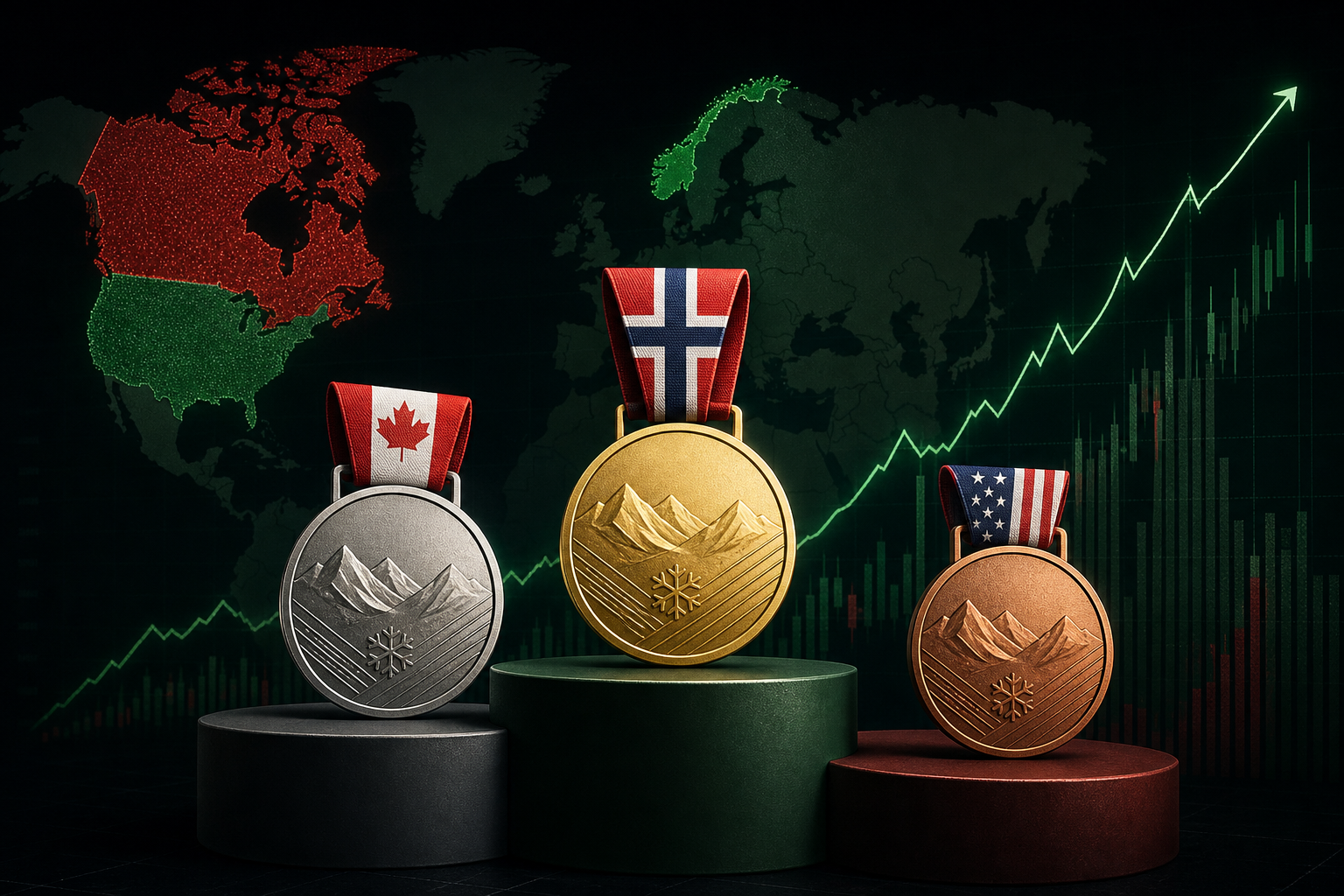
Norway leads nearly every 2026 Winter Olympics medal projection, with prediction markets giving it a 96% implied probability of leading the total medal table and a 98% implied probability of topping the gold medal table. The United States and Canada follow as the next strongest contenders, with Canada's analytics models projecting a near-record 27-medal haul across events including hockey and alpine skiing. Statistical models, prediction markets, and sportsbook odds each weight countries differently, and those differences tell you something about uncertainty at the country level. This article focuses on the top contenders and key disciplines where projections are strongest.
How the 2026 Winter Olympics Medal Table Is Officially Ranked
Every serious projection is shaped by one rule: the official Olympic medal table ranks nations by gold medals first, not by total medals. A country with 10 golds and 5 silvers ranks above a country with 9 golds and 20 silvers, which is why models that project Norway's dominance in gold-heavy sports like cross-country skiing treat it as the clear table leader even if another nation accumulates more medals overall.
The process follows three steps:
- Sort nations by the total number of gold medals won. [S1]
- Use silver medal counts as the first tiebreaker if gold medal totals are equal. [S2]
- Use bronze medal counts as the second tiebreaker for remaining ties. [S3]
The Milan-Cortina program offers 348 medals across its full schedule. With that many medals distributed across disciplines, a country that dominates one deep sport, such as cross-country skiing or biathlon, can accumulate enough gold medals to hold the top position even if a rival nation wins more medals overall.
Computer-based forecasting models, including those from Gracenote and Shoreview Sports Analytics, apply this gold-first logic when generating their projected tables. Prediction markets price the same outcome: the probability that a given country finishes first by gold medal count, not by total medals. Understanding that distinction is the starting point for reading any ranked projection correctly.
Norway: Why Every Model Picks the Same 2026 Winter Olympics Favorite
Norway is the consensus pick across every major forecasting source. The agreement is not coincidental.
Traders on the Kalshi prediction market assign Norway a 96% implied probability of leading the 2026 Games in total medals, and a 98% implied probability of winning the most gold medals. Those figures represent collective market judgment, not the estimate of a single analyst. When a market reaches that level of consensus, it reflects the aggregation of many independent assessments pointing in the same direction.
Sportsbook data reinforces the same view. FanDuel Sportsbook lists Norway as the heavy favorite to win the most gold medals at Milan-Cortina, with moneyline odds of -195. The gap between Norway and the field in those odds is wide enough that forecasters treat the question of who tops the gold table as effectively settled, and focus instead on the competition for second place.
The structural reason is straightforward. Norway's medal haul comes from sports with multiple events per discipline. Cross-country skiing alone offers over a dozen medal events at each Winter Games, and Norway has historically dominated both the men's and women's programs. Biathlon, which combines cross-country skiing with rifle shooting, adds further medal opportunities in individual, sprint, pursuit, mass start, and relay formats. A country that places multiple athletes in the top three across those disciplines accumulates gold medals faster than nations whose strength is spread across fewer events.
Speed skating and ski jumping contribute additional depth to Norway's projected total. These are not sports where Norway wins occasionally. They are sports where Norway fields multiple medal-contending athletes in the same event, which raises the probability of at least one gold even when individual outcomes are uncertain.
The 2026 Winter Olympics favorites question, at the top of the table, has a clear answer.
United States and Canada 2026 Winter Olympics Medal Predictions
Below Norway, the rankings become genuinely competitive. The United States and Canada are the two countries most forecasting sources place in second and third, though the order depends on whether you measure by gold medals or total medals.
Canada's total medal projection
The Shoreview Sports Analytics model projects Canada will earn 27 medals at Milan-Cortina, which would be its second-highest total in Winter Olympic history. That figure is driven by depth across multiple disciplines rather than dominance in any single one. Men's hockey is the most prominent single event: Shoreview estimates Canada's probability of winning gold in that tournament at 37 per cent, making Canada the projected favorite but not a near-certainty.
Alpine skiing, short-track speed skating, and freestyle skiing contribute additional projected medals to Canada's total. The 27-medal forecast reflects a model that accounts for current World Cup standings, athlete qualification results, and historical performance patterns at the Olympic level.
The United States and host-effect modeling
The United States is the second favorite to win the most gold medals at the 2026 Games, with FanDuel Sportsbook listing it at +200. Statistical models that account for proximity effects, including research published in the Textile & Leather Review, project a measurable increase in the US gold medal share tied to its status as the 2028 Summer Olympics host. The Bivariate-Hurdle-Tobit model cited in that 2026 study estimates a 0.75% increase in gold medal share for the United States, presented as a modeled estimate under specific assumptions, not a confirmed forecast.
The mechanism behind that projection is that nations hosting a major Games in the near term tend to invest more in athlete development and selection infrastructure in the preceding cycle. Whether that effect materializes depends on discipline-level performance in the months before Milan-Cortina.
2026 Winter Olympics Medal Predictions by Event: Hockey, Skiing, and Curling
Event-level predictions differ from country-level ones because a single sport can swing a nation's gold medal count by two or three. Three disciplines, hockey, alpine skiing, and curling, concentrate the most analytical attention heading into Milan-Cortina.
Men's ice hockey
Canada enters as the projected favorite in men's hockey, with Shoreview's model placing its gold medal probability at 37 per cent. That figure makes Canada the single most likely winner but leaves substantial probability distributed across the United States, Sweden, and Finland. Hockey tournaments are high-variance events: a single overtime loss in the quarterfinals can eliminate a gold medal favorite. That variance is why no model assigns Canada a probability much above that mark despite its historical dominance.
Alpine skiing
Alpine skiing spreads medals across six individual disciplines, downhill, super-G, giant slalom, slalom, combined, and team event, for both men and women. That structure means no single country monopolizes the gold medal count. Switzerland, Austria, and the United States each field multiple medal-contending athletes across disciplines. Italy, as the host nation, carries added attention: home-course familiarity and crowd support are factors some models weight modestly in alpine events.
Curling
An Elo rating model drawing on 1,287 match results from the World Curling Federation applied that data to project curling medal outcomes for 2026. Canada and Sweden rank as the strongest projected teams in both men's and women's curling. The United States and Switzerland appear as secondary contenders. Curling's round-robin format before knockout rounds means a single bad session can alter a team's path, which is why even strong Elo projections carry meaningful uncertainty.
The SportsLine Olympic Expert System, headed by analyst Mike Tierney who has covered nine Olympic Games, provides picks across gold medal and overall medal count futures for these disciplines. The system identifies longshot props with projected returns exceeding +2000, which signals where the model sees the largest gaps between market pricing and its own probability estimates.
Event-level forecasting is where the differences between models become most visible. A country-level projection aggregates across all sports. An event-level projection forces a specific answer about a specific race or tournament, and that specificity exposes the limits of any single methodology.
Ski Mountaineering: What to Know About the 2026 Olympics’ Newest Medal Sport
Ski mountaineering joins the Milan-Cortina program as a new Olympic medal discipline. The 2026 Games schedule includes 116 total medal events, and ski mountaineering accounts for several of them across individual and team formats.
The sport combines uphill climbing on skis with technical downhill descents. Understanding its race mechanics helps explain why it adds medal opportunities for countries that do not traditionally dominate the Winter Games.
A race follows this sequence:
- Begin the ascent using synthetic skins attached to the ski bases for traction on snow. [S4]
- Remove skis and carry them in a backpack during designated steep sections where climbing on foot is required. [S5]
- Strip the skins from the skis at the summit to prepare for the descent. [S6]
- Descend through gated slalom sections to the finish line. [S7]
- In team relay formats, transfer to the next teammate with a physical touch. [S8]
That format rewards a specific athletic profile: strong aerobic capacity for the climb, technical ski ability for the descent, and the physical coordination to transition quickly between modes. It does not map directly onto the skill sets of cross-country skiing or alpine racing, which means the medal pool draws from a different group of nations.
France, Switzerland, and Italy have produced competitive ski mountaineering athletes at the World Championship level. The host-nation factor applies here too: Italian athletes competing on familiar terrain in front of home crowds may carry a modest performance advantage that some models reflect.
Because ski mountaineering is new to the Olympic program, historical Olympic data for projections is limited. Models rely on World Championship results and World Cup standings rather than prior Games performance. That data gap increases uncertainty in event-level forecasts for this discipline more than for established sports.
How Are 2026 Winter Olympics Medal Predictions Made? Gracenote, Models, and Markets
Three distinct methodologies generate the projections that appear in coverage of the 2026 Games: statistical models, prediction markets, and sportsbook odds. Each produces different outputs and carries different assumptions.
Statistical models
Shoreview Sports Analytics and Gracenote are among the named forecasting systems that build projected medal tables from historical performance data, current World Cup and World Championship standings, and athlete qualification results. The Shoreview model produced Canada's projected 27-medal total. Gracenote applies a similar data-driven approach across all competing nations to generate full projected tables. Neither model claims certainty. They produce probability-weighted estimates that shift as qualifying results accumulate.
The Bivariate-Hurdle-Tobit model published in the Textile & Leather Review in 2026 takes a different approach, modeling structural variables such as GDP, population, and host-nation proximity effects rather than athlete-level performance data. That model's 0.75% gold medal share increase for the United States is a structural estimate, not a performance forecast.
Prediction markets
Prediction markets aggregate the judgments of many independent participants into a single implied probability. The Kalshi market data showing a 98% probability for Norway winning the most gold medals reflects collective market consensus, not an analyst's projection. The point is not who is right. It is that the market price represents aggregated information from participants who have different data sources, different models, and different incentives.
Sportsbook odds
Sportsbooks like FanDuel set odds based on their own risk management and the volume of money placed on each outcome. Those odds imply probabilities but are also shaped by liability management. The SportsLine Olympic Expert System analyzes these odds to identify where model projections diverge from market pricing, which is where its longshot recommendations originate.
Each method answers a slightly different question. Statistical models ask what the data predicts. Prediction markets ask what informed participants collectively believe. Sportsbook odds ask what price balances the book. Reading all three together gives a more complete picture than any single source alone.
How Prediction Markets Let You Trade on 2026 Winter Olympics Outcomes
Prediction markets are not sportsbooks. A sportsbook sets a fixed price and manages its own liability. A prediction market aggregates the judgments of many independent participants into a public implied probability, and that price moves as new information enters the market. The signal is the point. The contract is the mechanism.
That distinction matters for the Olympics specifically. The Kalshi market price for Norway reflects collective intelligence from participants with different data sources and different incentives, not a single analyst's estimate. It updates in real time as qualifying results, injury news, and athlete form data reach the market.
Previsão is a prediction market platform where users trade on outcome probabilities across sports, politics, and cryptocurrency price movements. Users select a specific outcome, see its implied probability and multiplier odds, and trade against real market volume. The platform covers both short-horizon events and long-horizon ones, which means the same infrastructure that prices a 15-minute crypto window can price a multi-month sports outcome like an Olympic medal table.
For the 2026 Winter Olympics, prediction markets offer something statistical models do not: a live probability that responds to new information between now and the Milan-Cortina closing ceremony.
Prices and plan limits verified as of October 2026.
FAQs
How do Kalshi and FanDuel odds for the same outcome differ?
Kalshi is a prediction market: its prices reflect the aggregated judgments of many independent traders, and those prices shift as new information enters the market. FanDuel is a sportsbook: it sets odds based on its own risk management and the volume of money placed on each side. Both imply a probability for the same outcome, but a sportsbook price also reflects liability balancing, which can push it away from the true probability when heavy public money lands on one side. Reading both together shows where the two methods agree and where they diverge.
What is the total number of medal events at the 2026 Winter Olympics?
The Milan-Cortina program includes 116 total medal events, with 348 individual medals available across those disciplines. Ski mountaineering joins the schedule as a new discipline, contributing several events across individual and team formats that did not exist in prior Winter Games programs.
Which country has won the most Winter Olympics medals all time?
Norway holds the all-time record for total Winter Olympics medals. That historical depth is part of why every current forecasting model, from statistical projections to prediction market implied probabilities, places Norway at the top of the 2026 projected medal table. Its dominance is structural, built on sports like cross-country skiing and biathlon that offer many medal events per Games.
Will Individual Neutral Athletes (AIN) affect the 2026 medal table standings?
Individual Neutral Athletes compete under a neutral designation and their medals are not attributed to any country. That means AIN performances do not add to any national medal count. If athletes who would otherwise represent a country with strong medal prospects compete as AIN, their results reduce that country's projected total without those medals appearing elsewhere in the official table.
Where are the 2026 Winter Olympics being held?
The 2026 Winter Olympics are held in Milan and Cortina d'Ampezzo, Italy. The Games are formally called the Milan-Cortina 2026 Winter Olympics. Competition venues are spread across multiple sites in northern Italy, with alpine events centered in Cortina d'Ampezzo and indoor events hosted in Milan.
Conclusion
Norway tops every serious 2026 Winter Olympics medal projection. Prediction markets and sportsbook data both list it as the heavy favorite by a wide margin, with a 98% implied probability of winning the most gold medals. The United States and Canada compete for second, with Canada's analytics models projecting a near-record 27-medal total and the US carrying a modest structural boost from its 2028 host-nation status.
To read these projections usefully, track which methodology produced each figure. A statistical model like Shoreview answers what historical data predicts. A prediction market answers what informed participants collectively believe right now. An event-level forecast in hockey or curling carries more uncertainty than a country-level one, because a single tournament result can shift the gold medal count by two or three. Start with the country-level consensus, then check the event-level models for the disciplines where the gap between contenders is smallest.